 Português
 Русский
 Español
 Francés
 ไทย
ไทย
 Bahasa Indonesia
 Việt
Việt
 Türk
Türk
 Melayu
 العربية

The Basic Working Principle of an Extruder
An extruder is a core piece of equipment used for processing high-molecular-weight materials such as plastics and rubber. Its working principle is based on the fundamental process of “feeding-plasticizing-forming.” The equipment primarily consists of components such as the feeding system, screw, barrel, heating system, and mold. First, granular or powdered raw materials are fed into the feeding system via a hopper. This system typically includes a metering device to ensure the raw materials are fed into the barrel at a uniform rate according to the set speed.
The screw inside the barrel is the key component of the extruder. Driven by an electric motor, the screw's threaded structure conveys the raw material from the feed port toward the mold. During this process, the heating system outside the barrel heats the raw material to a specific temperature—for example, when processing polyethylene (PE) plastic, the temperature must be raised to 160°C–230°C to gradually soften and melt the material. Simultaneously, the shear force and friction generated by the rotating screw exert work on the raw material, further accelerating the plasticization process and transforming the solid raw material into a viscous melt with flowability.
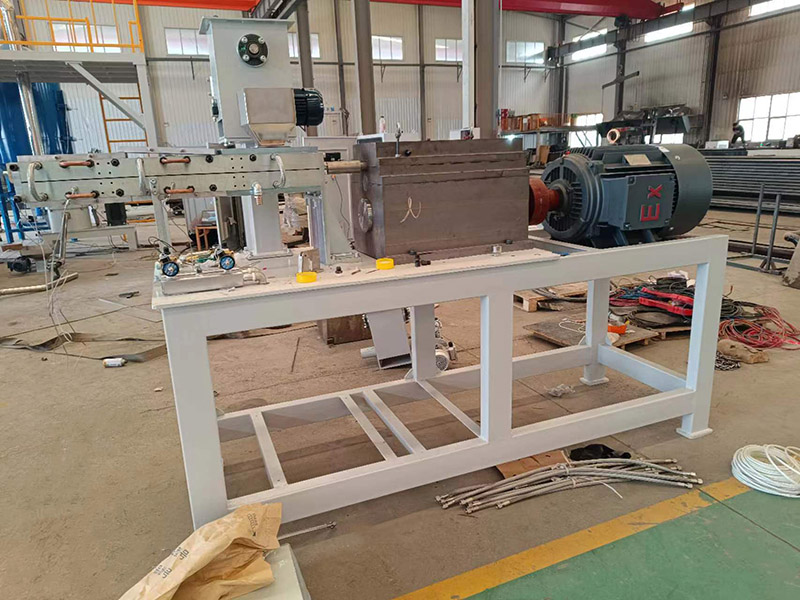
When the plasticized melt is conveyed to the front end of the barrel near the mold, a filter screen and a diverter plate are typically installed there to filter out impurities and ensure more uniform melt flow. The melt then enters the mold (also known as the die head), whose shape determines the final product's form.
After the melt is extruded from the mold, it undergoes a cooling and shaping process. For plastic products, water cooling is commonly used, where water tanks or spray systems rapidly cool the high-temperature products to transform them from a viscous flow state to a solid state, thereby fixing their shape. Rubber products may use air cooling or natural cooling to avoid internal stress caused by sudden cooling. The cooled products are then pulled out at a constant speed by a traction device and finally cut to the set length by cutting equipment, completing the entire production process.
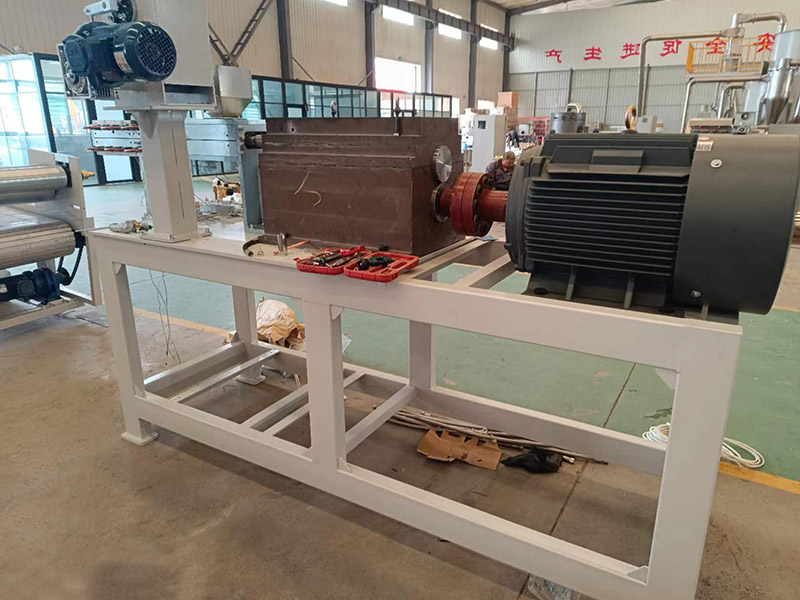
Modern extruders are also equipped with automated control systems that use temperature sensors and pressure sensors to monitor the temperature and pressure inside the barrel in real time. If the parameters deviate from the set values, the system automatically adjusts the heating power or screw speed. For example, if the barrel temperature is too high, the system reduces the heating power and increases the screw speed to accelerate raw material feeding and prevent melt decomposition. If the pressure is abnormal, it may indicate a mold blockage or insufficient raw material flow, requiring timely inspection and resolution. This closed-loop control mechanism ensures the stability of the extrusion process and the consistency of product quality.
Additionally, twin-screw extruders and single-screw extruders differ slightly in principle. Twin-screw extruders typically offer superior mixing capability and conveying efficiency, with the intermeshing of two screws enabling better dispersion of additives, making them suitable for complex processes such as plastic modification and blending; single-screw extruders, on the other hand, feature a simpler structure and lower cost, and are commonly used for producing single-material products such as films and pipes.


